

Introduction
I've been prescribing GLP-1 medications for nearly seven years now.
I've watched patients lose 40, 60, 80 pounds. I've watched A1C numbers drop from 9 down to 5.6. I've watched people walk into my office with knees that don't hurt anymore, blood pressure that's finally in range, and clothes that fit for the first time in a decade.
And I've watched the same people — the same people — sit across from me with that look.
You probably know the one I mean.
It's the look of someone who got everything they asked for, and somehow feels worse than when they started.
"Doctor, the shot is working. The weight is coming off. But I'm exhausted all the time. I'm sleeping a full eight hours and waking up like I haven't slept at all."
"I used to have so much energy. Now even small things feel like too much."
"I sit down at my desk after lunch and my brain just… stops. I can't focus. I can't think straight."
If any of that sounds like you — what you're feeling isn't laziness. It isn't depression in the traditional sense. It isn't "just getting older."
There's a real, biological reason this is happening.
Two reasons, actually. And once you understand them, you can finally do something about them.
What Is GLP-1 Fatigue?
Here's the first thing I tell every patient who comes in with this complaint:
Most people experience both at once, which is why it feels so impossible to fix.
You try one thing for the energy, you try another thing for the focus, and nothing seems to work — because you're treating one problem with a fix designed for the other.
So let's separate them.
The First Kind: Physical Fatigue
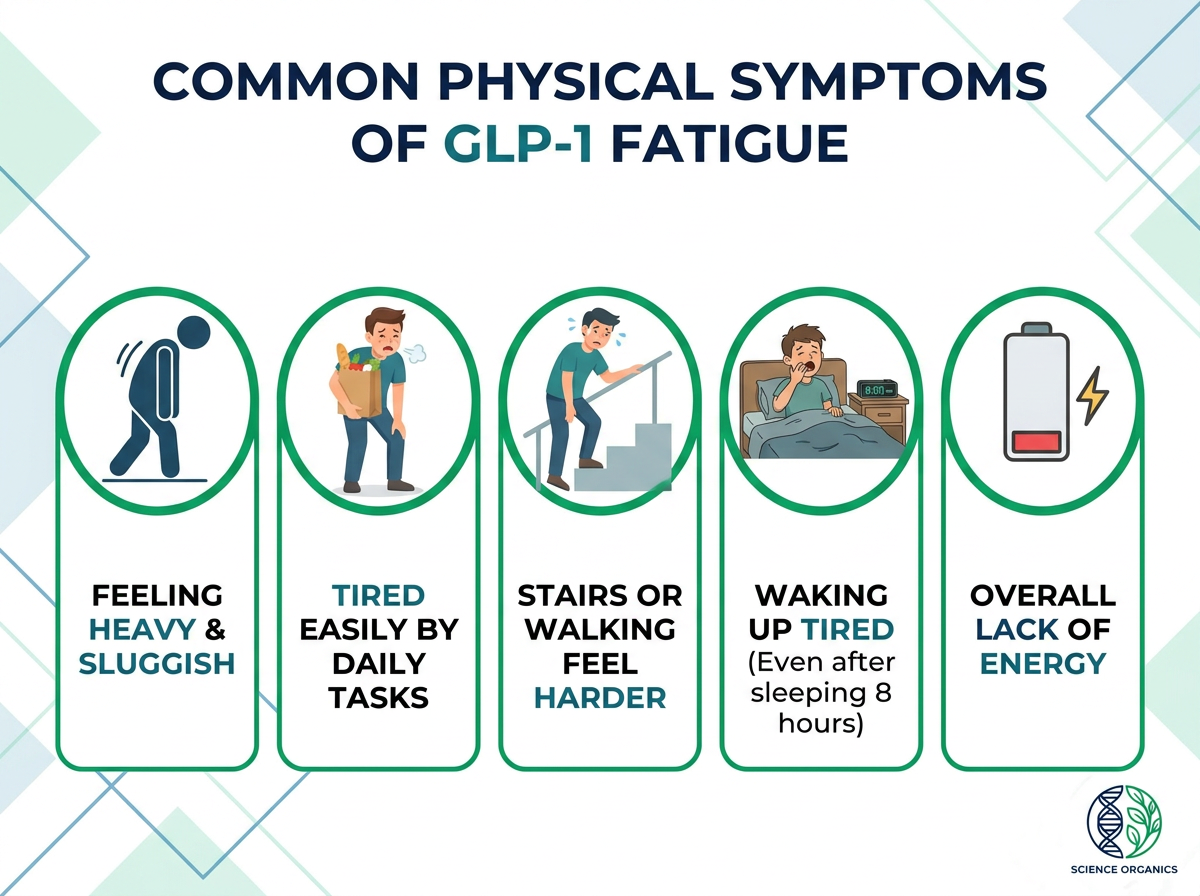
This is the body-level exhaustion. The kind you feel in your muscles, your legs, your bones.
- It's the heaviness when you stand up from the couch.
- It's getting winded carrying groceries from the car.
- It's the way every flight of stairs feels like it has ten extra steps now.
- It's sleeping a full eight hours and waking up like you slept four.
Things you used to do without thinking — running errands, playing with your kids, getting through a workday without dragging — suddenly take real effort.
The body just doesn't have the fuel it used to.
It's not that you don't want to do these things. It's that your body genuinely can't show up the way it used to.
The Second Kind: Mental Fatigue
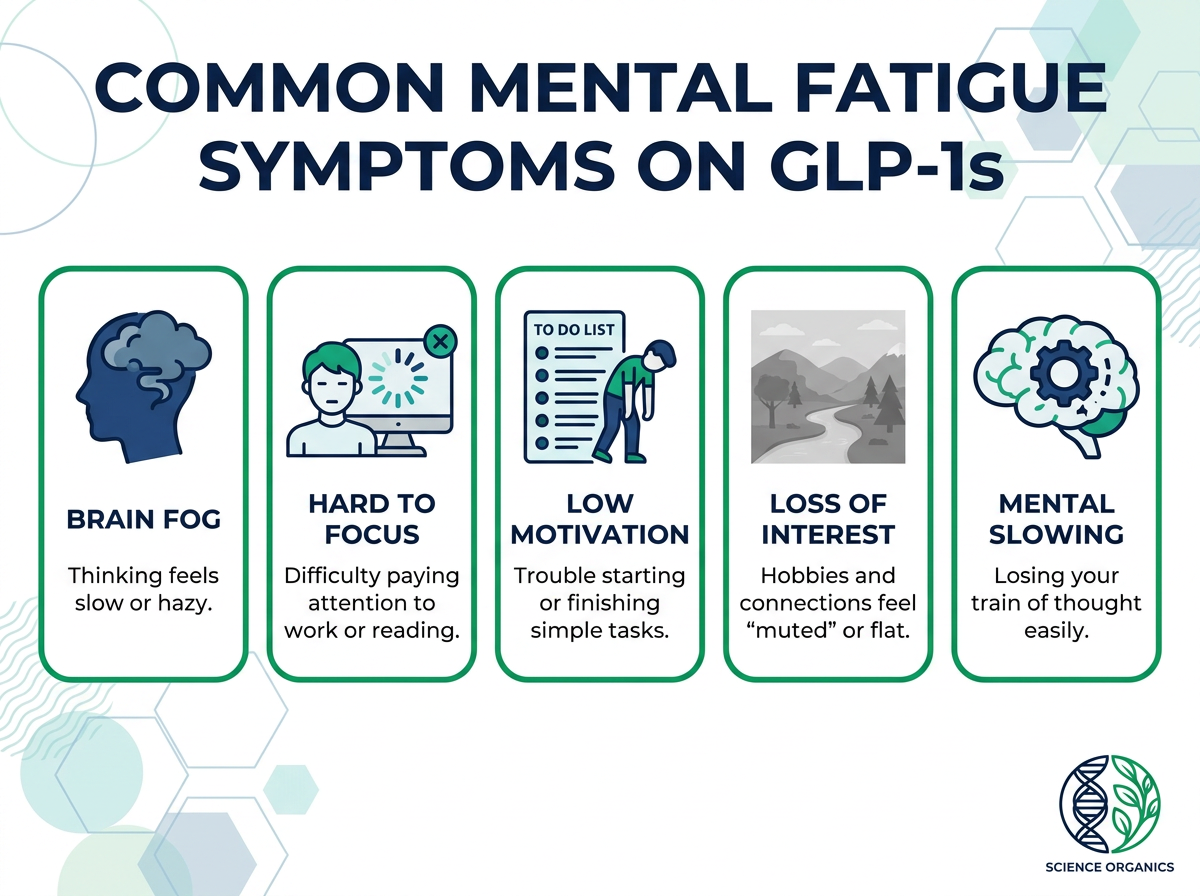
This is the one that scares people the most. Because it doesn't feel physical — it feels like you're changing.
- It's the brain fog.
- It's the 2 PM wall where your thoughts just stop.
- It's reading the same paragraph three times and not absorbing any of it.
- It's starting a sentence and losing track of where it was going halfway through.
It's the lack of motivation.
You sit down to do something simple — answer a message, pay a bill, finish what's in front of you — and you just… don't.
Not because you're being lazy. Because your brain doesn't seem to register why it would matter.
Someone you love asks if you want to do something together, and you'd rather stay home. Not because anything is wrong. But because nothing feels especially right either.
You're not depressed. You don't feel sad. You just feel… off.
If you've felt either of these — or both — keep reading. Because the why matters more than you think.
Physical Fatigue: Why It Happens
The physical side is honestly the easier one to explain. So let's start here.
GLP-1 medications work — primarily — by changing how much you eat. They slow down how fast your stomach empties, they tell your brain you're full faster, and they quiet down the constant "food noise" most people on these shots talk about.
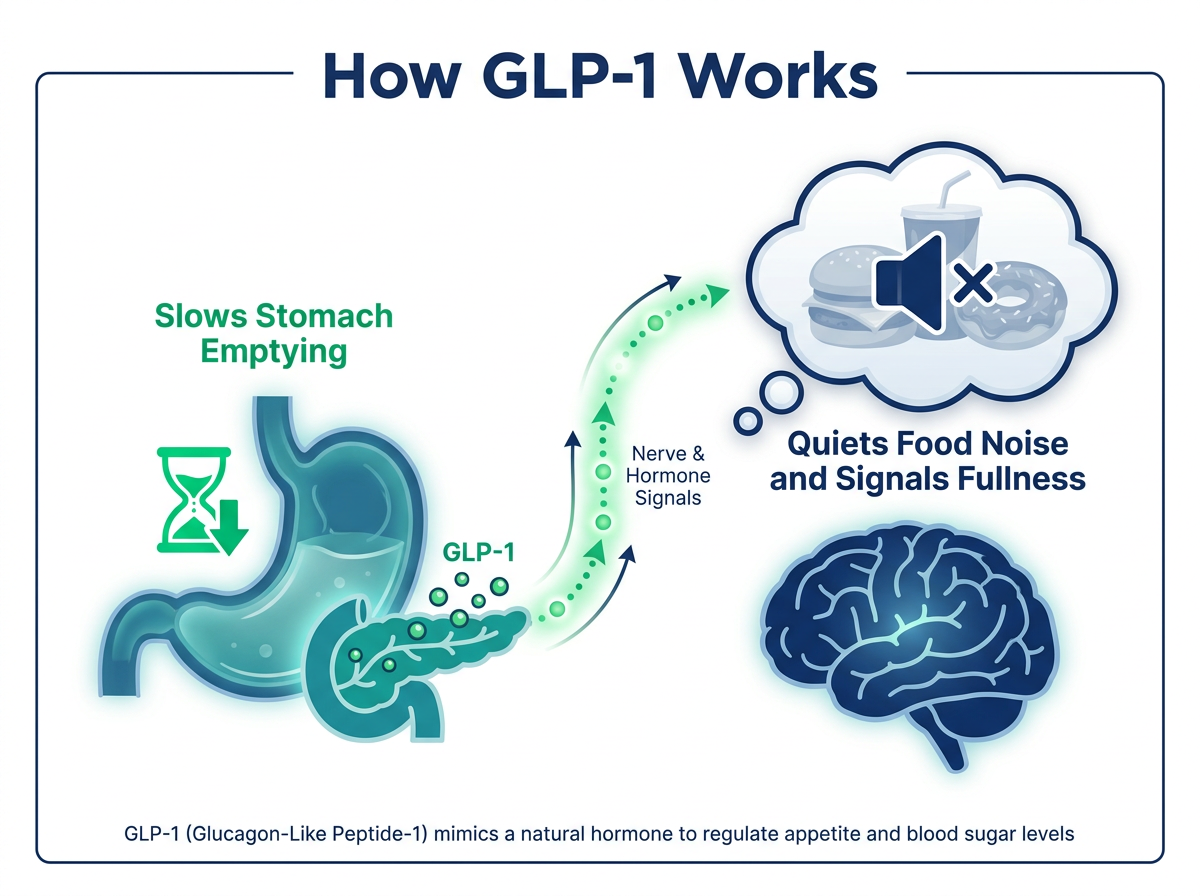
That's the goal. That's the whole point.
But there's a tradeoff most patients don't fully realize:
Less protein. Less iron. Less B vitamins. Less magnesium. Less zinc. Less of every single nutrient your body uses to make energy.
Here's what that looks like in practice:
Cause #1
Lower calorie intake
Calories are fuel. When fuel drops sharply — especially if you're going from 2,200 calories a day down to 1,000 or 1,200 — your body has less to work with.
It will start prioritizing the essential systems (heart, brain, lungs) and pulling energy away from the non-essential ones (workouts, hobbies, anything that requires extra effort).
Cause #2
Blood sugar shifts
GLP-1 medications stabilize your glucose, which is part of why they work so well for diabetes.
But for many people, this also means your blood sugar runs lower than it used to.
And lower glucose, even within a "normal" range, can feel like fatigue, light-headedness, or that mid-afternoon crash where everything just shuts down.
Cause #3
Mineral depletion
When you eat dramatically less food, you're getting dramatically less of the minerals that drive energy production at the cellular level.
- Magnesium is involved in over 300 enzymatic reactions in your body — including the ones that literally produce ATP, the energy currency of every cell.
- B12 is essential for nerve function and red blood cell production.
- Iron carries oxygen.
Without these in adequate amounts, your cells can't make enough energy, no matter how much you sleep.
Cause #4
The cost of side effects
And here's a quieter one — if you're dealing with nausea, reflux, sulfur burps, or constipation alongside everything else, your body is burning energy to manage all of that too.
Chronic low-grade discomfort is exhausting in a way most people underestimate.
So the formula is simple, even if the experience isn't:
Your body isn't broken. It's just running on empty.
Physical Fatigue: How To Fix It
The good news is the physical side responds well to a handful of basic, deliberate changes. None of these are revolutionary — but most patients aren't doing them consistently.
Step 1
Hydrate seriously
Most of my patients on GLP-1s are mildly dehydrated and don't realize it.
Aim for at least 80–100 ounces of water a day. Add electrolytes if you can — sodium, potassium, magnesium. Plain water alone isn't always enough.
Step 2
Eat with intention, not just appetite
This is the hardest one. Because GLP-1s suppress your hunger, you can easily go an entire day without eating much — and then wonder why you feel terrible.
Set times to eat, even when you're not hungry. Aim for 60–80 grams of protein a day, minimum.
Protein is non-negotiable.
Step 3
Replenish what you're losing
Mineral and vitamin depletion is the silent driver of GLP-1 fatigue. The big ones to focus on:
- Magnesium (specifically the glycinate form — better absorbed, gentler on the stomach) for cellular energy and muscle function.
- B12 (methylcobalamin form) for nerve function and red blood cell production.
- Zinc and copper in the right ratio (around 20:1) for enzyme function and immune support.
- Vitamin D3 because most GLP-1 users test deficient and it directly affects energy and mood.
- Vitamin C to help absorption of the minerals above.
These don't have to be exotic. They just have to be there. At therapeutic doses, not the token 5% of daily value you find in a generic multivitamin.
Step 4
Move daily, even when you don't want to
A 20-minute walk after a meal does more for your energy levels than an hour of high-intensity exercise. Start small. Build slowly. Your body will follow.
If you do these four things consistently for two to three weeks, the physical fatigue will lift for most people.
But — and this is the important part — if you're still tired after fixing the physical side, that means you're dealing with the second kind. The mental kind.
And that's a different beast entirely.
Mental Fatigue: Why It Happens
This is where it gets more complicated, so bear with me.
Most prescribers — myself included — were trained on the primary mechanism of these medications: how they work in the gut to suppress appetite and stabilize blood sugar. That part is well-established and on every drug label.
What's less well known, and what only really emerged in the research over the last few years, is this:
GLP-1 medications — semaglutide, tirzepatide, all of them — work not only in your gut, but they also make the receptors in your brain less sensitive to dopamine and serotonin.
Specifically, they target the reward system. The part of your brain that says "that was good, do it again."
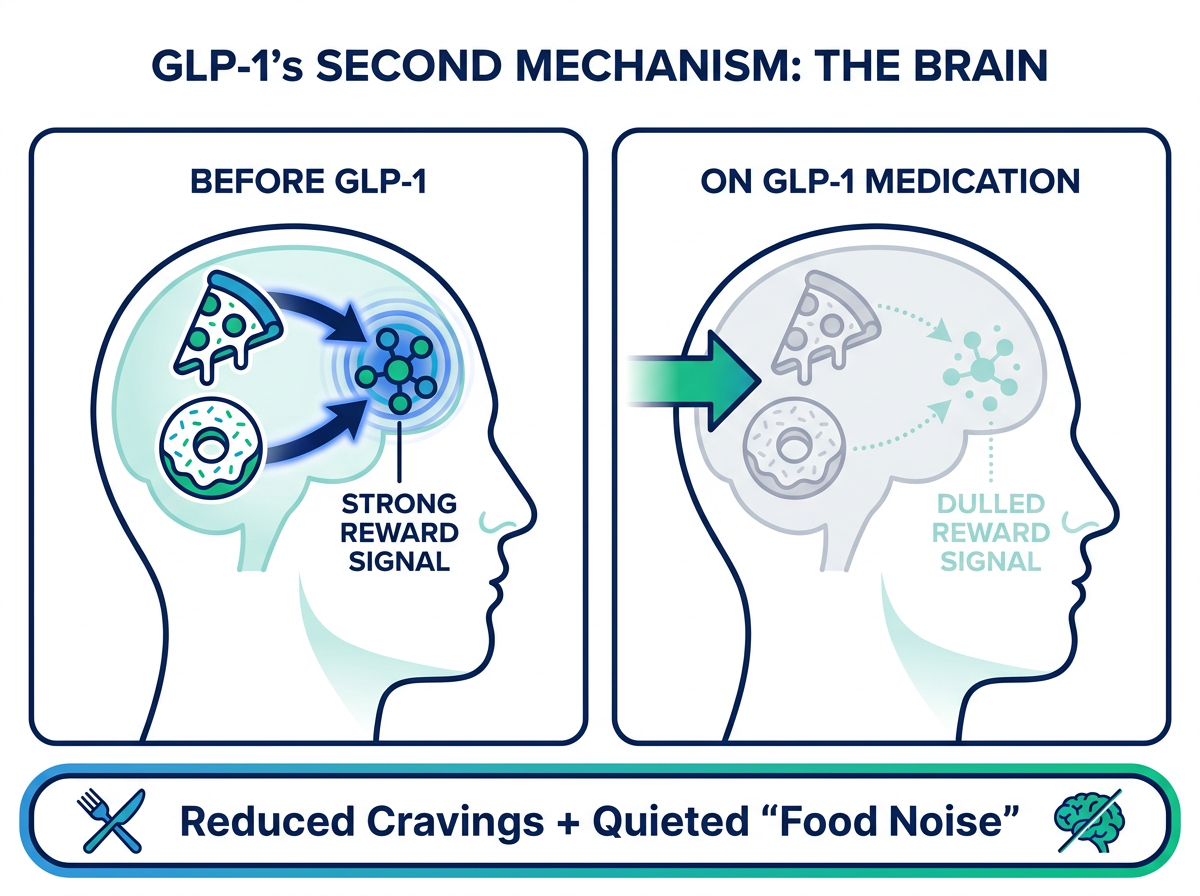
That's the second mechanism of how the medication works. By dulling the reward signal from food, you stop craving it. The food noise goes quiet. You eat less. The weight comes off. The blood sugar stabilizes.
It's elegant. And it's effective.
But there are two consequences most people are never told about:
Consequence #1
The reward system doesn't just work for food
Here's the part that catches everyone off guard.
Your brain doesn't have separate reward systems for food, exercise, accomplishment, social connection, hobbies, or sex. It has one reward system. One set of receptors. One pathway.
So when GLP-1 medications dampen that pathway to reduce food cravings — they're also dampening it for everything else.
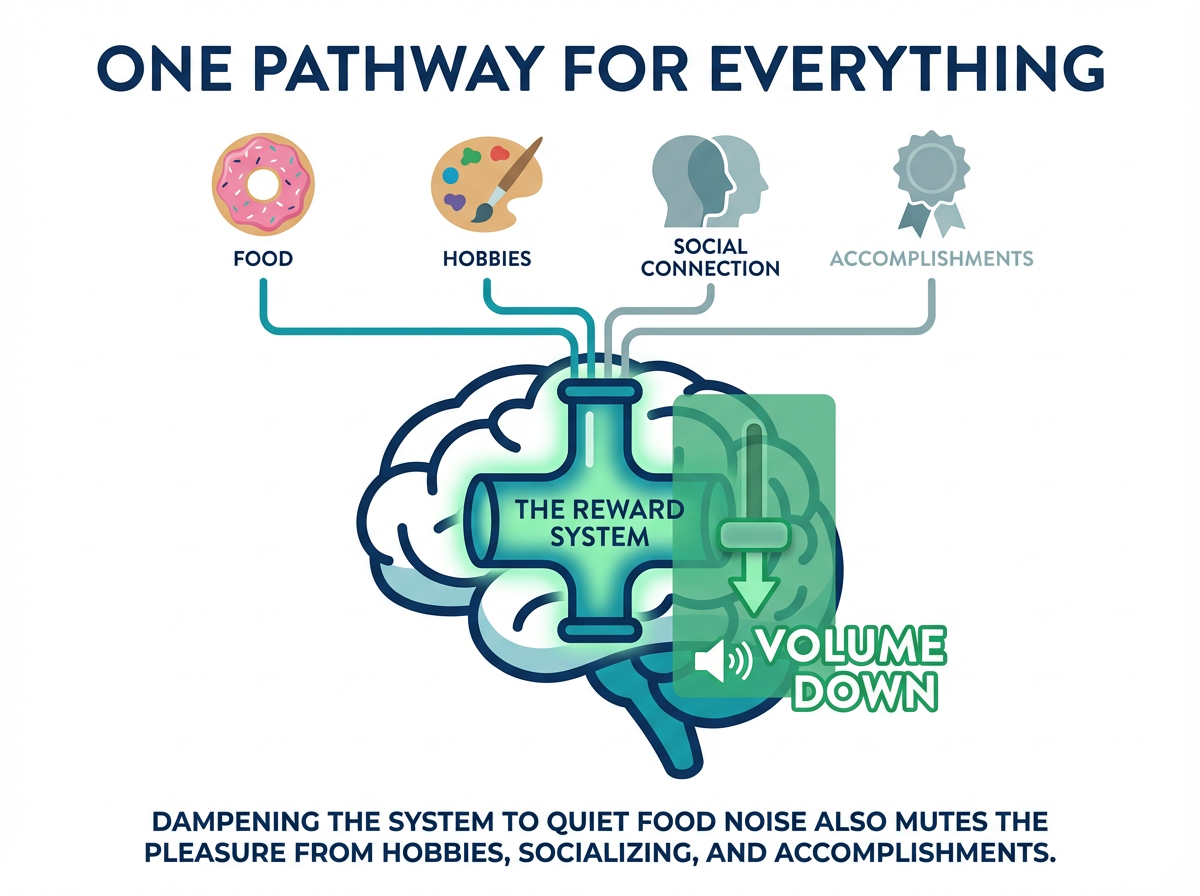
The promotion at work? Doesn't feel as good as it used to.
Finishing a project? Should feel satisfying. Doesn't.
Your kid making you laugh? Registers, but it doesn't land the way it used to.
Your hobbies, your friendships, the little daily wins — they all start to feel… muted.
And in a percentage of patients, this goes further:
The reward signal dampens so much that they tip into full anhedonia — the clinical term for the inability to feel pleasure.
Or what most patients describe simply as "the flat feeling" or "not caring about anything anymore."
Consequence #2
The brain goes into energy conservation mode
Here's the second piece, and it's the one that explains the fatigue.
Your brain is essentially a cost-benefit machine. It's constantly calculating: Is the effort worth the reward?
When the reward signal is working, your brain is willing to spend energy on things. You feel motivated. You feel sharp. You take initiative. You feel like doing things.
But when the reward signal is dampened — when the brain isn't getting much of a payoff from anything — it starts to shut down effort.
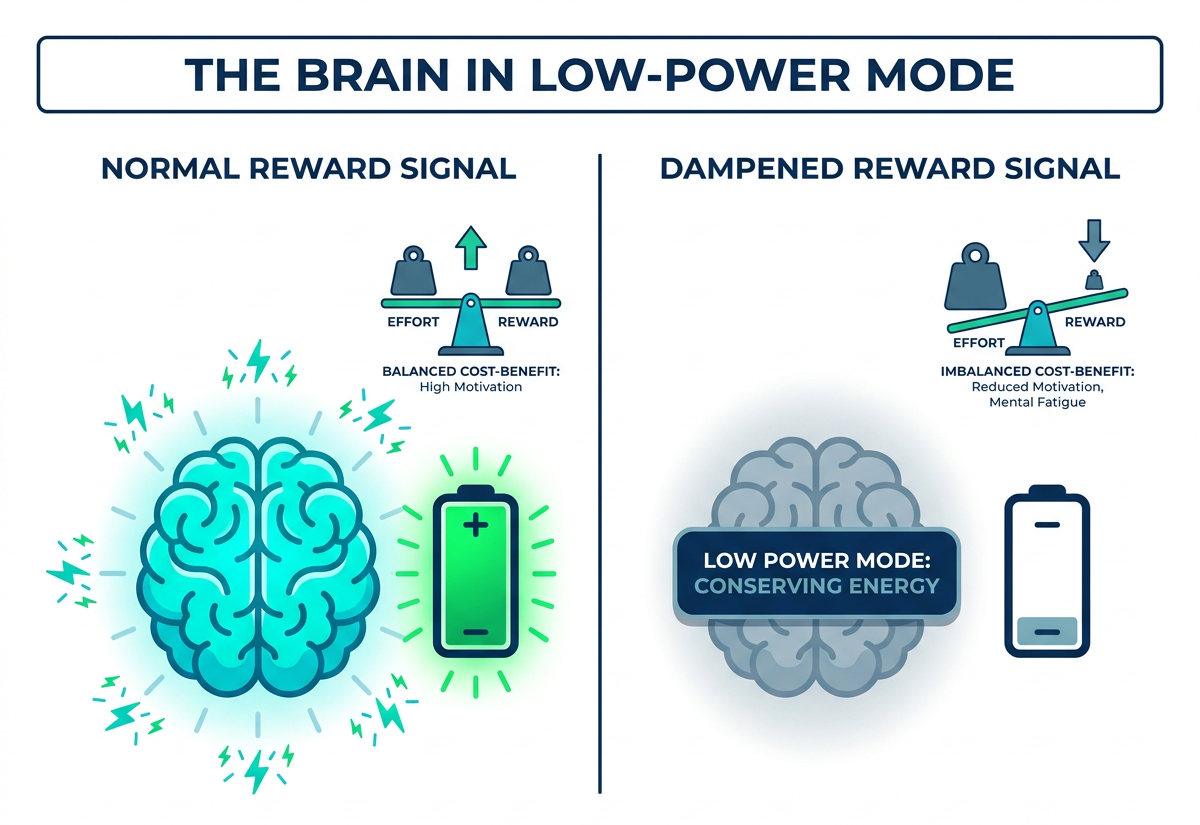
It thinks: Why work hard if nothing feels especially good anyway?
So it slips into a kind of low-power mode. Minimum effort. Conserve resources. Don't bother.
I know that sounds almost philosophical. But it's not — it's a real function of the nervous system. The brain physically reduces its energy expenditure when the reward system is suppressed.
That's the brain fog. That's the 2 PM crash. That's the constant feeling of dragging through the day. That's the cotton-wrapped-head sensation so many of my patients describe.
And here's the part I have to be honest about: the longer your brain stays in this state, the deeper it goes.
Think about it like a muscle you stop using. If you stopped using your left arm for two years, the muscles would weaken and shrink. Atrophy.
Same thing happens to your reward pathways the longer they stay suppressed. The receptors become less and less responsive over time.
Which is why you can't just wait this out. It doesn't get better on its own. If anything, it slowly gets worse.
Mental Fatigue: How To Fix It
Now, when I first started understanding this, my instinct was the obvious one: if the brain has less dopamine and serotonin signaling, just give it more, right?
So I'd recommend dopamine precursors. L-tyrosine. Mucuna pruriens. 5-HTP for serotonin support. Even, in some cases, considering low-dose SSRIs.
And it almost never worked.
When I finally sat down with an integrative medicine colleague to really dig into why, she said something that reframed the whole problem.
The dopamine and serotonin are still there. The chemistry isn't depleted. The receptors have just gone numb to it.
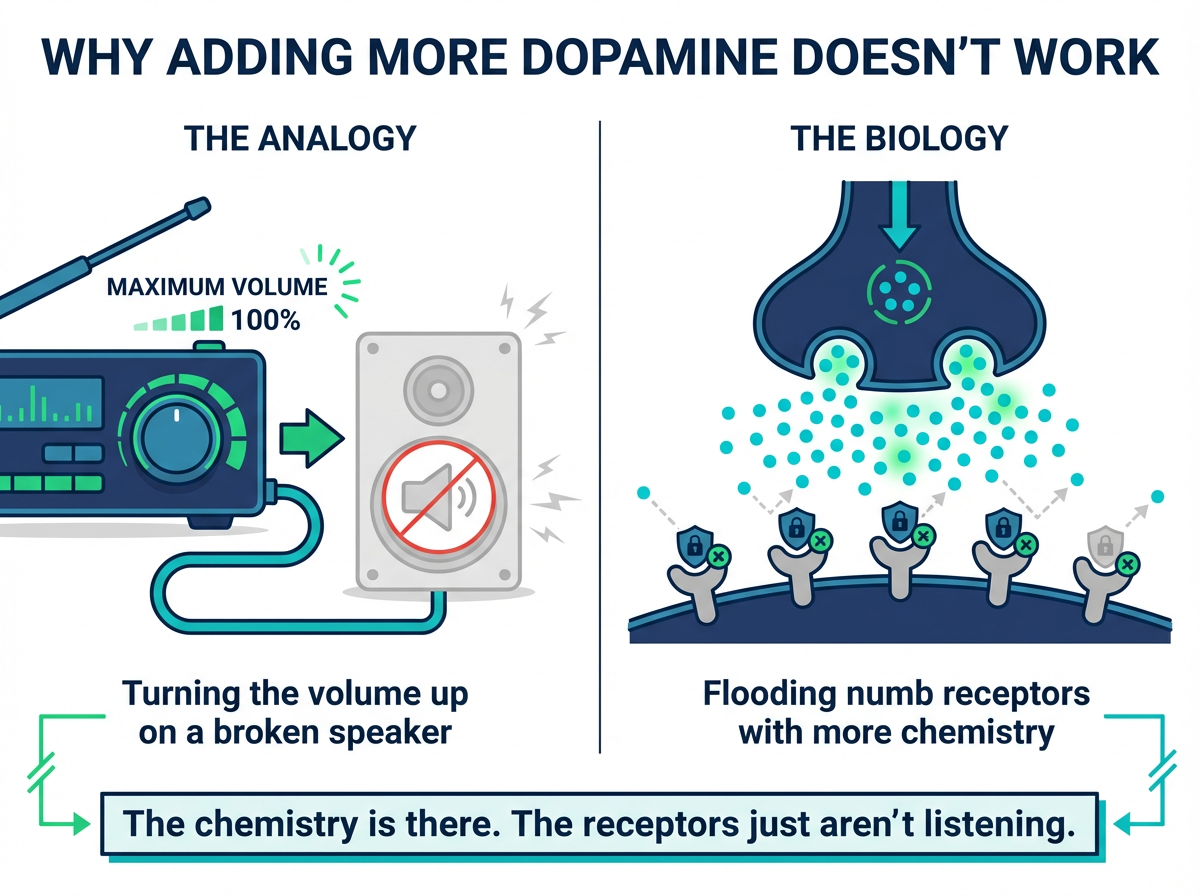
Adding more dopamine to numb receptors is like turning the radio louder when the speaker is broken. It doesn't help.
And in the case of serotonin — pushing too much can actually be dangerous, leading to serotonin syndrome, which is a real medical emergency.
What you actually need is something that restores receptor sensitivity — wakes the system back up so the chemicals you already have can do their job again.
After years of working through this with patients and reviewing the research, I came to understand that mental restoration on a GLP-1 isn't a single fix.
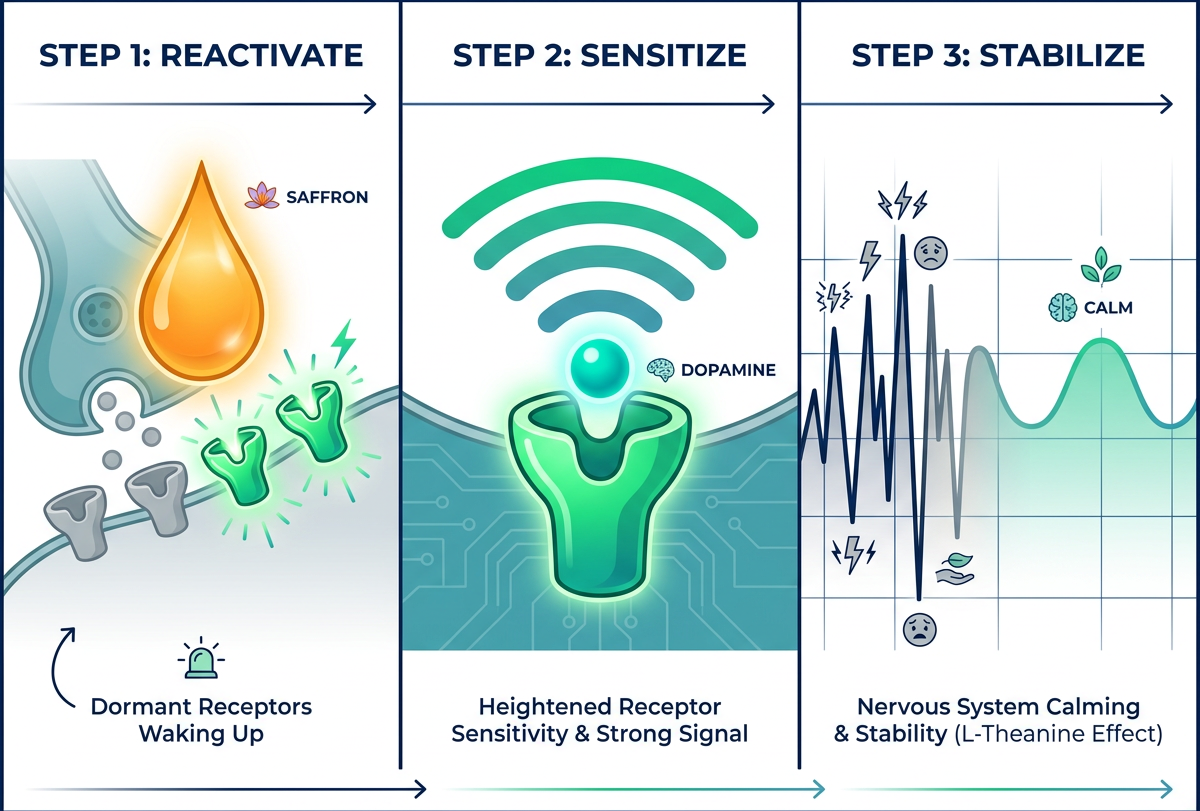
It's a three-step protocol.
Step 1
Wake the system back up
This is where you start. The receptors have gone numb, and before anything else can help, they need to be reactivated.
Three specific compounds — crocin, crocetin, and safranal — have been shown to do exactly this.
They're naturally occurring molecules found in concentrated form in saffron extract. Not ground saffron from the spice rack, and not generic saffron pills — pharmaceutical-grade extract specifically standardized for these three actives.
The research on this is genuinely impressive.
A 2022 study published in the Journal of Affective Disorders found that this kind of saffron extract improved anhedonia scores by 68% (!) in patients — comparable to prescription antidepressants, but with significantly fewer side effects.
What's important is the mechanism. These compounds don't add more dopamine or serotonin to the system. They restore the responsiveness of the receptors that have gone numb. They wake the brain back up to the chemicals it already has.
Step 2
Make the receptors more sensitive once they're awake
Waking up the system is only half the work.
Once the receptors come back online, they need to actually be sensitive enough to respond properly to the dopamine and serotonin reaching them — otherwise you've reactivated the pathway, but the signal still isn't getting through clearly.
This is where myo-inositol comes in.
Myo-inositol works specifically on dopamine D2 receptor sensitivity. If saffron is the wake-up call, myo-inositol is what makes sure the receptors are actually listening when the call comes in.
The two compounds together are significantly more effective than either alone — which is why saffron-only supplements often underperform for patients with deeper, longer-running fatigue.
Step 3
Calm the nervous system through the transition
This is the step almost nobody talks about, and it's the reason most patients give up on the protocol before it has a chance to work.
When your nervous system has been operating in suppressed, low-power mode for months — sometimes years — and you start to bring it back online, the transition can actually feel destabilizing.
Patients report feeling wired, on edge, anxious, or "weird" in the first one to two weeks. It's not a side effect of the supplements. It's the nervous system recalibrating after a long period of being dampened.
This is where L-theanine does its work.
L-theanine modulates GABA — the main calming neurotransmitter in your nervous system — keeping things steady through the transition period.
With it, the recalibration feels smooth. Without it, patients often feel destabilized, panic, and stop taking the protocol before week three when the actual benefits start to show up.
The three compounds above do the heavy lifting on the brain side. But over years of running this protocol with patients — and refining it through what worked and what didn't — I came to understand that none of them work as well in a body that's running on empty.
So underneath the three-step protocol, four foundational nutrients consistently emerged as non-negotiable for GLP-1 patients specifically:
- B12 in the methylcobalamin form — because it's what your brain actually uses to produce cellular energy at the mitochondrial level.
Without enough of it, your neurons can't fire at full capacity, no matter what else you're taking. - Magnesium glycinate — a cofactor in over 300 enzymatic reactions in the body, including the ones that synthesize dopamine and serotonin in the first place.
You can't restore a system that doesn't have the building blocks to produce its own chemicals. - Vitamin D3 — directly tied to mood regulation, and the vast majority of GLP-1 patients I test come back deficient.
It's one of the simplest and most under-addressed pieces of the puzzle. - Zinc and copper in the right ratio — roughly 20:1, both essential for neurotransmitter function.
As a bonus, they also support hair health, which most of my GLP-1 patients are quietly struggling with at the same time.
These don't restore the system on their own. But without them, the three compounds above don't have the materials they need to work.
To Sum Up
So here's what I tell my patients now, and it's what I want to leave you with.
-
1
The physical side is mostly about what you're putting into your body — calories, hydration, minerals, protein. Fix those, and you'll feel a lot of the heaviness lift.
-
2
The mental side is about what's happening inside your brain — the dampening of the reward pathways and the slow drift into low-power mode. That one needs targeted support: saffron, myo-inositol, L-theanine, plus the foundational nutrients that help the system come back online.
You don't have to choose between the medication working and feeling like yourself.
You can have both.
I've seen hundreds of patients have both. But you have to actually address both sides of the equation — not just the physical, not just the mental, both.
A Note on Supplements
For a long time, I was building this protocol the hard way.
A patient would come in, we'd go through everything, and they'd walk out with a list — saffron extract from one company, myo-inositol from another, magnesium glycinate from a third, B12 from a fourth and so on. Five or six different bottles to source, track, and remember every single day.
And here's what I learned watching this play out over and over: it doesn't work.
Not because the protocol was wrong — but because almost nobody actually keeps up with six separate supplements.
Half my patients took them inconsistently. The other half quit within a month because it got expensive fast. The ones who stayed consistent got results. The problem was almost nobody stayed consistent.
So I started looking for a single formulation that had everything, at the doses I was actually recommending.
Specifically, I needed something with:
- Saffron extract standardized for crocin and safranal content (the bioactive compounds that restore receptor function)
- Myo-inositol (enhances dopamine receptor sensitivity)
- L-Theanine (reduces anxiety without sedation, supports GABA function)
- Magnesium glycinate (the absorbable form, for cellular energy and neurotransmitter synthesis)
- Zinc and copper (in the right ratio for mineral depletion and hair)
- B vitamins (methylated B12, vitamin C, vitamin D3 for cofactor support)
- Clean ingredients, no fillers, therapeutic doses
Not the token amounts most supplements use — just enough of an ingredient to print it on the label, but nowhere near enough to actually do anything.
I'll be honest about what I found: most of the market falls short. Generic multivitamins with trace doses. Single-ingredient saffron pills at a fraction of the clinical amount. Products formulated for vague "mood support" or "energy" — nothing built specifically for what GLP-1s do to the body and the brain.
The only formulation I found that actually contained everything on my list — at the clinical doses, in the right forms, built specifically for GLP-1 patients — was one called Zafira Recovery Foundation.
I'm not being paid to say this. I have no financial relationship with the company.
I'm mentioning it because I checked it the way I check everything: line by line, dose by dose, against the research. It held up.
So I started recommending it to my patients — and for the first time, I watched adherence go from maybe a third of them to nearly all of them.
Not because it worked better than the piecemeal protocol, but because it was the protocol, in one bottle, taken twice a day. And the protocol only works if you actually follow it.
But what happened next is really what convinced me.
I mentioned it to a few colleagues — other physicians I trusted — and they started trying it with their own GLP-1 patients. Then I brought it up with people I'd gone through training with years ago, clinicians now scattered across the country in their own practices.
Several of them ran it with their patients too. And the feedback kept coming back the same: the patients stayed consistent, and the results held up.
Before long, a whole group of us — practices in different states, people who'd studied together a decade ago — were ordering it in bulk, independently, because it was simply the most reliable way any of us had found to deliver this protocol.
Then something happened that I didn't expect.
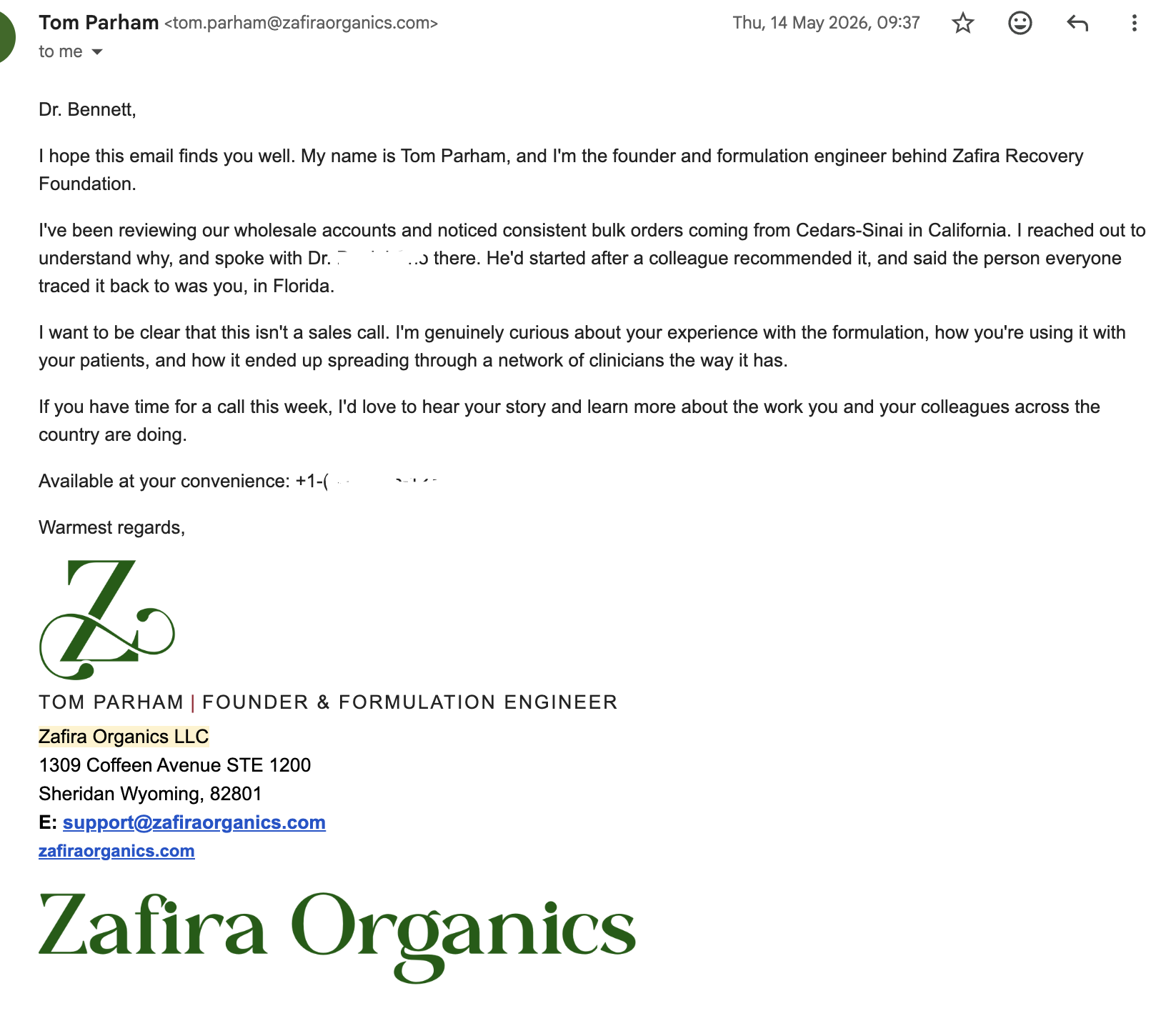
I got an email from Tom Parham — the founder of the company that makes it.
He'd noticed the bulk orders coming from clinics and wanted to connect.
We got on a call.
I told him what I'd been seeing — the protocol I'd run for years and how it had quietly spread through a network of clinicians who'd all arrived at the same conclusion independently.
He listened, and then he told me something I didn't expect:
We talked for over an hour.
He told me about the research behind the formulation, the clinical studies the doctors had conducted, how he'd worked with them to create a supplement with exact therapeutic doses — not the token amounts most companies use.
And then he made me an offer.
"Yes," I said.
I said no.
I didn't want anything that could quietly shape how I talk to my patients, or how I write something like this.
Most of my patients are already paying a small fortune for the medication itself. The last thing they need is another expensive monthly bill stacked on top of it.
Eventually, we agreed on something that felt right for both of us.
No profit for him. No commission for me.
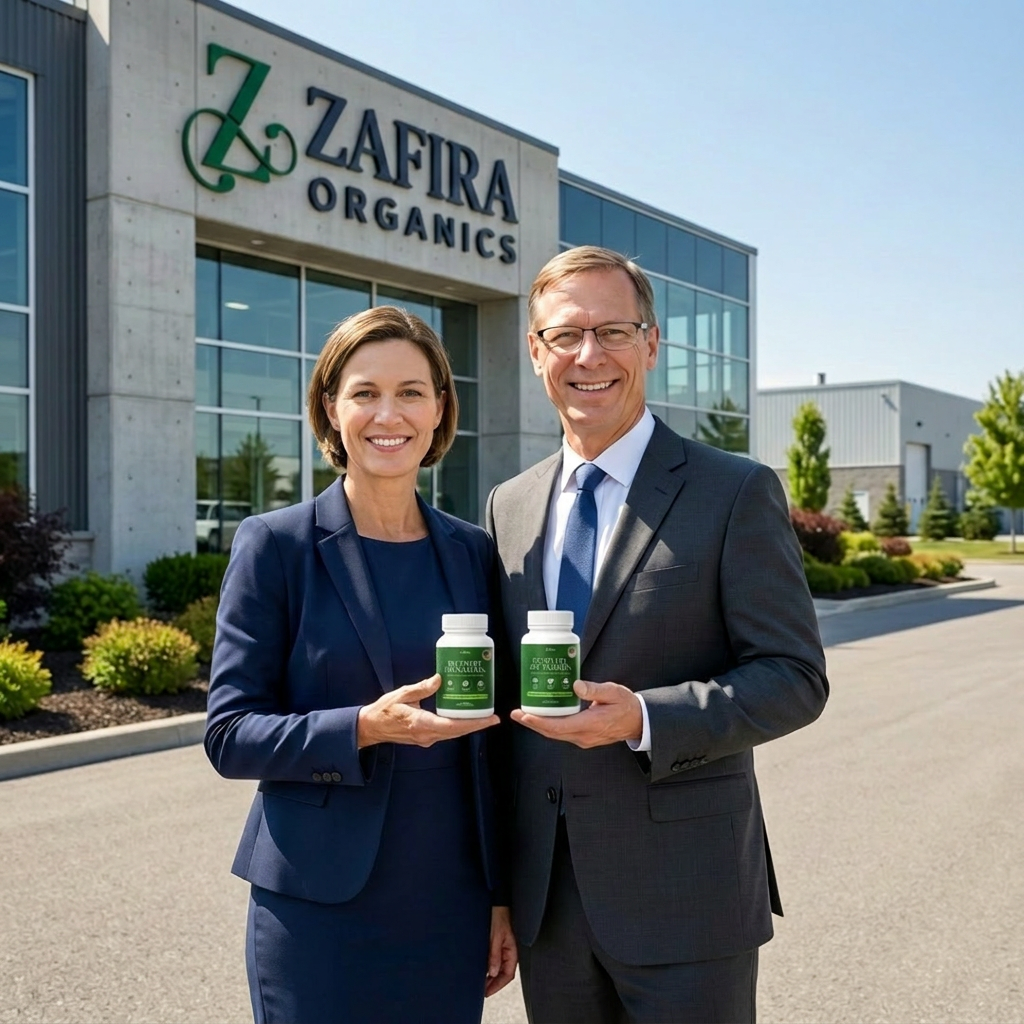
First meeting with Tom Parham — Denver, CO | May 16, 2026
If you want to look into it, the link below has that discount built in.
And if you don't — that's genuinely fine. Take everything I've explained in this article and build the protocol yourself, bottle by bottle, the way I used to do it with patients.
The mechanism is what matters.
The product is just the most consistent way I've found to get there.
But please — whatever you choose — don't just keep waiting it out.
The fatigue won't fix itself. The longer it goes on, the deeper it goes. And you have far too much life in front of you to spend it dragging through fog.
ZAFIRA
The GLP-1 Support Protocol
60-day money-back guarantee (no return required)
Monthly refill option available
Regular price: $84.90
Reader price: $54.90
Zafira Recovery Foundation
$84.90 $54.90 $30 OFF
Dr. Bennett has no financial relationship with the company and receives no compensation from product sales.
— Dr. Rachel Bennett, MD
This article reflects clinical observations from personal practice and a review of available research, with no compensation from any mentioned company. R. Bennett receives no financial benefit from product sales.
P.S. — If you're experiencing severe brain fog, prolonged exhaustion, or symptoms of depression on a GLP-1 medication, please don't dismiss it as "just part of the process." Talk to your prescribing physician. These symptoms are real, they're biological, and they're addressable.
P.P.S. — One last thing. If you decide to try anything I've described — whether it's the supplement, the hydration changes, the mineral support, or all of it — give it time. The pathways we're talking about don't restore overnight. Most patients start to notice subtle shifts by week 2 or 3, with fuller restoration around weeks 6 to 8. Be patient with your body. It's been working hard.